

My blog is now at its own domain: ahotcupofjoe.net! Be sure to visit there and change your book marks and RSS feeds.
Filed under: Archaeology | Leave a comment »


My blog is now at its own domain: ahotcupofjoe.net! Be sure to visit there and change your book marks and RSS feeds.
Filed under: Archaeology | Leave a comment »

Neanderthals probably weren't stupid
It has long been thought that one of the reason Homo sapiens eventually dominated the hominid line, colonizing Africa and Europe beginning at around 40,000 years ago and eradicating or out-competing the Neanderthals, was that they were technologically advantaged. The idea was that because H. sapiens had better stone tool technologies, they had the edge, so to speak, on their Neanderthal cousins who already occupied the lands H. sapiens were migrating into.
<Read More of this Post>
Filed under: Archaeology | Leave a comment »
Filed under: Archaeology | 2 Comments »
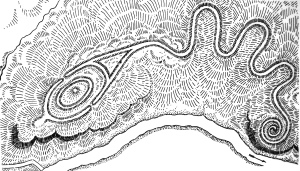
There is just so much wrong with this.
The only energies in the mound that can be empirically shown to exist are infrared energy, absorbed from the sun, and the energies involved in chemical and molecular bonding. Each of these energies are well-understood and present in all rocks and earth. There isn’t any special energy, as yet undefined, that has been shown to exist in mounds. In this paragraph, Provod here several pseudoscientific and nonsense terms and phrases. For instance, what does “energetic degree” mean? Energy is something that can be empirically measured and simply refers to the ability to do work. There isn’t anything mystical about that. Provod implies that the shape of the mound affects the mound’s energy, but this simply isn’t the case. The only useful energy in the Serpent mound (or any other mound or megalithic structure) is infrared, which is absorbed during the day and emanated during the night.
People used to supply their body energy by the use of all kinds of megalithic structures.
Filed under: Pseudoarchaeology | Tagged: energy, new age, Pseudoarchaeology, pseudoscience | 15 Comments »

Photo by Carl Feagans
Recently, I was in Ohio on vacation and I snapped this photo while on a ferry ride between South Bass Island and the mainland. Every few meters during the trip I noticed dead fish floating near the surface.
Seeing so many dead fish is disconcerting to say the least and asked one of the deckhands on the ferry but he didn’t seem to know what I was talking about. Is it possible that he never noticed all these fish floating on the surface? Because of the busy nature of being on vacation, I nearly forgot the matter until I was looking over some my photos today. The fish appear to me to be Freshwater Drum (though I could very well be wrong), so I googled “lake erie dead fish” and started following links to see if there was any news on the issue. Apparently there is.
According to the New York State Department of Environmental Conservation (DEC), there is a problem with not just fish but mudpuppies as well. I was in Ohio near South Bass Island, not the New York side of the lake, but it is all one big body of water. The article explains that fish die offs have a variety of causes, including temperature changes and diseases. One notable culprit, according to the article, is Type E botulism toxin, a poison produced by by Clostridium botulinum, which can be harmful to humans if infected fish are eaten. This bacterium has been problematic in the past in the Great Lakes, so it may be making a comeback.
It occurred to me also that there could be alien toxins or diseases being introduced from the bilges of ships that enter the Lake from outside via the canal systems that link Lake Erie to the Hudson River. It might also be that nitrogen from agricultural run-offs into the lake create algae blooms that, in turn, create anoxic zones in the lake where the fish simply choke to death then rise to the surface.
On a brighter note, but perhaps not for those who suffer from ophidiophobia, the Lake Erie Water Snake population seems to be increased enough that the snake may soon be removed from the endangered list. This nonvenomous snake was placed on the endangered list in 1991 after nearly being eradicated by people who mistook it for poisonous. Though it isn’t poisonous, they’re certainly willing to bite when handled and they have an anticoagulant that makes the tiny wound continue to bleed for a while, appearing as if you opened up an artery.

Photo by Carl Feagans
I shot this picture at the ferry dock when my daughter noticed it sunning on the rock. They’re most commonly seen in the spring and further investigation revealed several dozen more of his friends, also hanging out on the rocks. Most of them tangled in knots of six or seven.
If anyone has information regarding the dead fish in Lake Erie or links, please share. I’m definitely not an expert on the subject and only admit to having a few thoughts and questions on the subject, not answers.
Filed under: Science | Tagged: ecology, lake erie, ohio, pollution, Science | 1 Comment »
Remote Central hosted the Four Stone Hearth on July 16th and I somehow completely over looked it. Tim always does a great job and if you haven’t read the posts at the blogs he linked to, now’s as good a time as any. Click here to read it.
The next installment of the Four Stone Hearth anthropology carnival will be hosted at Testimony of the Spade on July 30, 2008 -there’s plenty of time left to work up submissions and send them in (you can find Mangus’ email address at the end of his “About” page). If you’re interested in hosting the FSH, drop Martin Rundkvist a line.
Filed under: Archaeology | Leave a comment »
Okay, I thought of adding this response as a comment, but since it ended up being so lengthy, I decided to make a separate post. The original comment is here and was caught by the Akismet as spam. I’ve since approved it to be visible.
A response to John Lucidi
First, I’d like to mention that your post was caught in my spam filter (Akismet) due to the number of links you included, so it wasn’t a matter of my not wanting your comment to appear. I just don’t look at posts caught by Akismet very often since it’s almost always pure, unadulterated spam. I have, I believe, read your comment posted on other sites, so one could make an argument that copy/paste behavior by someone who admits an interest in an industry’s success is actually spam. Indeed, I hold that it is.
Nevertheless, I’m willing to approve the comment if only to address the points you’ve made for public record.
The first thing I noticed in your comment was that the Bridgestone link [PDF] was actually to a marketing pamphlet hosted on your own site rather than an actual independent study or measurement as you claim. I contend that Bridgestone has a financial interest in the “nitrogen-filled tire” industry, and note that this pamphlet is not available on their domain. In fact, the only mention of nitrogen in tires I could locate was this quote:
Because race tires are subject to much higher operating temperatures, the air to inflate them is filtered to remove moisture. Moisture inside a race tire could become steam, creating potential problems. Most teams actually replace this filtered air with nitrogen.
My contention that Bridgestone has a financial interest is largely based on the web address included on the marketing pamphlet which is to http://www.trucktires.com and they doubtless have either an affiliation with or provide their own nitrogen filling service for over the road truckers. Big rig trucks have tires that include far more sidewall rubber surface and larger volumes of gas within, and the tires are subjected to wear and use that far exceeds that of the average commuter, so it may actually be that there have been studies done on OTR truck tires that reveal a benefit to having nitrogen-filled tires.
But this doesn’t relate or equate to any benefit to having nitrogen -filled tires on a passenger car. If we concede for a moment (and I’m not actually doing so without seeing an independent study that isn’t a marketing brochure for a company attempting to make a buck) that there is a benefit, which outweighs the exorbitant cost, for OTR truckers to have nitrogen-filled tires, it still must be considered that the tire of a truck has a far greater surface area of sidewall rubber and a larger volume of gas within which may actually create faster rates of diffusion for both gas molecules. There are more molecules and more available avenues of egress.
So, your “proof” isn’t actually proof of anything other than the fact that Bridgestone Firestone has an affiliation or at least some sort of interest in nitrogen-filled tires for OTR trucks. I saw no mention in this marketing pamphlet (your “proof”) that referenced an independent study.
There is, however, an independent study conducted by consumer reports that was conducted on passenger car tires. Their results showed that in one year nitrogen-filled tires lost 2.2 psi while tires filled with normal air mix lost 3.5 psi. This is a difference of 1.3 psi over a full year and certainly nothing close to 4 to 6 times “faster than nitrogen.” I also found it interesting that you’re quick to mention that rate as are many other advocates of this expensive and unnecessary method of filling tires, but never is the rate itself defined. What are the units measured over what period of time? Moreover, the Consumer Reports study also demonstrates that both molecules are diffused over time, with nitrogen diffusing at a slightly slower rate, which is something that I readily conceded to in my initial post.
With regard to tire wear from chemical aging, I’ve again conceded that pure, nitrogen would halt this. From the inside! Surely you realize that oxygen and moisture in the air outside the tire can and will permeate the side wall of a tire. Normal atmospheric pressure, after all, is still a pressure and the molecules of O2 and H2O are variable excited depending upon pressure and temperature and will collide with the same rubber sidewalls from the opposite side. Fortunately, this isn’t a concern since chemical wear, for the average commuter, occurs at a rate that is far slower than physical wear. I have yet to replace a set of tires due to chemical aging -inside or out. I realize I can’t speak for you, but I’m willing to bet $5.00 via Paypal that I can find an independent source that shows the most common reason for tire replacement is worn tread.
You say that “[i]t is a well proven fact within the tire industry that nitrogen inflated tires maintain their pressure better than air filled tires.” I don’t deny this. But there isn’t enough concern with tire pressure loss (both molecules will effuse) that I’m willing to pay for nitrogen. There’s no need for the average consumer to fill their tires with nitrogen since they need only check (or have checked) their tire pressure regularly. I don’t think I’ve ever had an oil change that didn’t include this as a matter of course and I regularly check my own.
There is, of course, the argument you’ve posited that the average consumer doesn’t check their tire pressure and that at least one tire is under-inflated, etc.
But this argument is utter bollocks when examined closely. The under-inflated tire is rarely due to diffusion of air molecules through the side-wall and is nearly always because of some other issue such as a puncture, fissure, poor seal, or faulty valve stem or valve. This is logically the case since if conditions are equal for each tire, an anomaly must have an alternative explanation other than diffusion or gas molecules permeating the sidewalls. This is an important point since each of these issues create points of egress that are large enough for both molecules. At this point, Graham’s Law takes over and the nitrogen will diffuse at a faster rate. This is not a matter of debate, it’s physics. QED.
Additionally, if we were to concede that pressure loss were problematic due to the owner not participating actively in preventive maintenance, then we also have to remember that nitrogen also diffuses and looses pressure. Therefore, what’s needed isn’t to charge $60.00 per tire to replace air with nitrogen but to educate the public on the importance of preventive maintenance checks and services. If the owner just gets their oil changed at a reputable service station, their tires will be checked and pressurized if necessary.
The “average consumer is ignorant” argument is like saying the average person doesn’t floss or brush twice daily so they should visit their dentist once a month for a professional cleaning.
Anyway, thanks for dropping by.
Filed under: skeptical | Tagged: nitrogen, nitrogen filled tires, skeptic, Skepticism | 21 Comments »
Looking through my spam filter I find the following:
Cfeagans
Hello. You may recall that I posted the below entry on your blog, Hot Cup of Joe, countering some of your arguments against nitrogen tire inflation. I was just curious to know why you decided not to publish it? I was always under the impression that the beauty of blogs was that you could often see differing points of view and readers could make their own determination.
That’s only the first paragraph. What follows is a list of links, which is why Akismet caught it as spam. I’m not convinced that it isn’t. It looks like someone going around all the blogs reposting the same copy/paste propaganda. I’ll probably approve the comment later today, but I want to review it first.
Filed under: Archaeology | 3 Comments »
This is an entry submitted for The Giant’s Shoulders blog carnival, the “Classic Papers” category.
Binford, Lewis R. (1962) Archaeology as Anthropology American Antiquity, 28 (2), pp. 217-225
Lewis Binford is considered by many to be one of the most influential archaeologists of the 20th century. During his teaching stint at the University of Chicago (1961 to 1965), this paper was published in the journal American Antiquity and helped Binford establish a paradigm that is still used today which is that there is a necessary relationship between anthropology and archaeology. Today, archaeologists refer to this as “processual archaeology” and there are many professors that still teach the “Binfordian” school of thought when approaching archaeological questions. One of Binford’s concerns was always to approach archaeological questions with a scientific perspective.
This paper begins Binford’s passion for arguing a processual method of archaeological research which includes logical positivism and the hypothetico-deductive model, scientific methods that rely on falsification, observation and hypothesis testing. While others before Binford, notably Gordon Willey and Phillip Phillips in 1958, argued that American archaeology is anthropology, Binford takes the idea to task in “Archaeology as Anthropology.”
Binford held that it was one thing to explicate the material record but another thing altogether to explain the material record in detail. For instance, it might be obvious when looking at an archaeological site to observe that at a given period in time a given culture migrated. But to explain the whys and hows of that migration, it requires a more holistic approach to analyzing the artifacts within the site. Indeed, it may require comparing and contrasting with artifacts from other periods or other sites of similar environmental and socio-demographic pressures. From these, Binford asserted, archaeologists can formulate and test hypotheses and make predictions.
For Binford, “undifferentiated” and “unstructured” views of artifacts within the material record were “inadequate” and he called for a “systematic and understandable picture of the total extinct cultural system.” One that incorporates strict scientific methodologies to provide useful data to the explanations of cultural evolution. And he was dead set against merely equating material culture with technology.
Binford proposed three major classes of artifacts and a “category of formal stylistic attributes.” Adapted directly from “Archaeology as Anthropology,” they are:
One of the things that makes this such a seminal paper is that Binford not only establishes his assertions and what he believes the future of archaeology should become, but he details why. More than this, he provides a working example of his proposed methods at work by using the Old Copper Complex of the Western Great Lakes as an example.
The Old Copper Complex can be dated as far back as 6000 BCE and, while they initially created copper tools, later assemblages (toward 3000 BCE) reflected a return to stone and bone, with copper being used primarily for symbolic and ornamental functions. This has been cited as a case of “cultural devolution” since it seems counter-intuitive to abandon the superior material of copper as a technology for tools only to return to stone and bone.
However, Binford quite gracefully demonstrates an explanation that goes beyond merely explicating the obvious. He drew upon what was already established as understood by anthropologists about egalitarian societies and their transformations as populations increase, creating more competition for status. He works out for the reader how it is neither efficient nor an economic expenditure of energy to create copper tools without recycling the material. He shows how the culture doesn’t recycle or rework copper tools since so many are found in disrepair in the archaeological record and none appear to be reworked. Moreover, copper goods are almost always found as part of burial goods.
If, Binford asserts, durability were a factor, then some mechanism should have found its way into the society to retain the copper tools rather than dispose of them with the dead. Since this isn’t the case, the conclusion is that they were not considered more durable when compared with stone and bone.
Binford spends several pages on the explanation, which I won’t do. To summarize, he posits that egalitarian societies cherish the achievement of the individual, which allows the individual to gain status among the group. Technomic items of exotic material, painstaking created, and elaborately decorated were considered symbolic of achievement. These status symbols would be personalities and thus subject to disposal at the death of their owners, hence the artifacts found in burial sites.
As populations continued to increase, according to Binford, so did the selective pressures that give individuals a need to communicate status. Differential roles within society emerged, giving rise to the appearance of a new class of socio-technic items, formerly the technomic items. Stone and bone again find their utility and copper is relegated to non-utilitarian functions, such as jewelry.
Lewis Binford’s philosophy of archaeology lives on in the students of his methods. “Binfordian” is a term that most American students of archaeology in colleges and top online schools have probably encountered. Many are very likely to consider themselves to be of the “Binfordian” mold. In other, later, publications, Binford went on to refine and perfect his perspective of processual archaeology, but it’s my opinion that “Archaeology as Anthropology” was the seminal paper that first showed the glimpse of things to come. Reading it today, Binford’s wisdom and the clarity of his words ring clear. There is an objective and knowable past that can be explained if the right methodology is employed. I’ll close this post with the last half of Lewis Binford’s concluding paragraph:
As archaeologists, with the entire span of culture history as our “laboratory,” we cannot afford to keep our theoretical heads buried in the sand. We must shoulder our full share of responsibility within anthropology. Such a change could go far in advancing the filed of archeology specifically, and would certainly advance the general field of anthropology.
Filed under: Archaeology, Carnivals | Tagged: Archaeology, binford, Blogging, giant's shoulders, lewis binford | 4 Comments »
I looked at my wife and saw a bit of hesitation. She was buying it. Literally, if I dindn’t stop her. “Ahem,” I got her attention and she snapped out of it. “Isn’t air already 78% nitrogen?” I asked the finance manager. “Uhh… well I’m not a scientist,” he replied with a sheepish grin. My wife, fully back to her senses smiled broadly, pointed at me and said, “but he is!” I’m not, but having stayed at my share of Holiday Inn Expresses, and having paid some attention in my Chemistry classes, I knew $5.00/tire every time they got low wasn’t an expense I wanted. And, if we filled a tire with air somewhere else, it would be $60 to service the tire and fill it back up with nitrogen. The tire that already had 78% nitrogen.
1. Do nitrogen-filled tires maintain proper pressure longer? The premise for this claim is that nitrogen is a larger molecule than oxygen. It is. Only slightly. But let’s not omit the fact that we’re talking about molecules here and not just the element. Oxygen and nitrogen are both diatomic molecules. Nitrogen actually has less mass than oxygen, so Graham’s Law dictates that it diffuses a bit faster than oxygen. However, since the actual size of the oxygen molecule (O2) is a bit larger than that of a nitrogen molecule (N2), this only applies if the opening from which the molecules are effusing from is large enough to permit the largest of the two. In such cases, N2 will diffuse faster.
The question, then, becomes, are the pores in rubber (assuming there are such pores) smaller than the N2 molecule but larger than the O2 molecule? I don’t know the answer to this. Nor could I find any literature in the few minutes I searched, but if anyone has a citation to an independent (i.e. non Nitrogen Tire industry) study or bit of research, I’m interested. Without digging out my old chemistry textbook, I’m willing to tentatively accept Wiki Answers on the sizes of N2 and O2 molecules: N2 is roughly 300 picometers while O2 is slightly smaller at 292 picometers. I’m open to revising these figures if someone cites a more reliable source, but I can’t imagine that there’d be any reason for the link to be more than slightly wrong.
2. Does rubber oxidize faster when exposed to oxygen rather than pure nitrogen? I’d expect so. The real questions are: a) how to you keep oxygen on the outside of your tires from causing oxidation?, and b) does it really matter to me since every single tire I’ve ever replaced was because of worn tread and not oxidation?
3. Why do I give a shit whether or not the oxygen in my tires will fuel the fire of my fiery crash? If the explosion is powerful enough to consume the oxygen in the surrounding air leaving only my tires as reserve fuel, I suspect I’m going to be a crispy critter anyway.
As for 4. and 5., I’m not that arsed for time that I can’t continue my routine of checking my tire pressure every 3,000 miles when I change my oil. In fact, nearly every time I’ve ever checked my tires at 3k, they’ve either been dead on for the proper psi or just a pound or two off. Whenever I’ve had to fill more than that, it’s been either because of a faulty valve or a nail in the tire itself. I suspect that the resulting points of egress in a faulty valve or pucture would create holes large enough for either O2 or N2 to escape through effusion. So, in that case, Graham’s Law would be in effect and N2 would escape faster than O2.
The bottom line: if nitrogen becomes a free option, easily obtainable (i.e. cheaper and easier than the $5.00 Walmart compressor that I plug into my cigarette lighter), I’ll use it since there’s a very slight chance I won’t need to top off my tire pressure as often. But, as long as I have to pay for it or even just drive to the dealer for it, I call bullshit!
Nitrofill is a scam. Nitrogen-filled tires for general consumers is a scam.
Filed under: Archaeology | 86 Comments »
 Hot Cup of Joe